
World
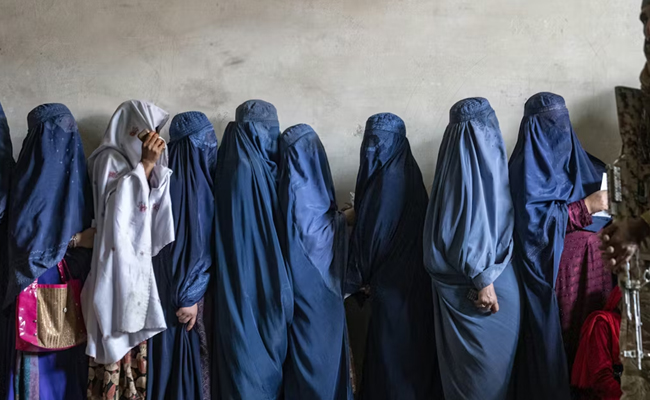
Since the Taliban returned to power in Afghanistan, the condition of women has severely deteriorated. Women and girls are being treated as second-class citizens, with little to no value in society. Afghanistan has become the only country in the world where girls and women are effectively banned from education.
The Taliban government has removed protections for women and girls facing gender-based violence. It has also created discriminatory barriers to healthcare access. Women are banned from playing sports, visiting parks, or moving freely in public spaces.
Strict hijab and mahram (male guardian) rules have drastically curtailed women’s freedom. Women cannot travel, seek medical treatment, or even appear in public without a male guardian. They must fully cover their faces and are prohibited from singing or raising their voices in public. Beauty salons have been shut down, and personal freedoms such as wearing makeup or cutting hair have been restricted.
In a recent and highly controversial move, the Taliban has reportedly approved a new law that effectively legalizes domestic violence. The law, approved by Taliban supreme leader Hibatullah Akhundzada, grants formal backing to acts of violence against women.
Under the new provisions, a husband is allowed to physically “discipline” his wife or children, as long as no bones are broken and no visible external wounds are caused. Even if a husband seriously injures his wife, he may face only up to 15 days in jail.
While women are technically allowed to file complaints, they must prove their injuries in court. However, they are required to remain fully covered while appearing before a judge—raising serious questions about how injuries can be examined. Moreover, a woman must be accompanied to court by her husband or another male family member. If the husband himself is the abuser, this requirement makes justice nearly impossible.
The law also states that if a woman visits her relatives without her husband’s permission, she could face up to three months in prison.
Article 9 of the new law reportedly divides society into four categories: religious scholars, upper class, middle class, and lower class. Punishments are determined not by the severity of the crime but by the offender’s social status. Religious scholars may receive only “advice,” upper-class individuals may be warned, middle-class offenders may face jail, while lower-class individuals could receive imprisonment along with harsh corporal punishment.
The Taliban has also fully repealed the 2009 Law on the Elimination of Violence Against Women, introduced by the previous government. Furthermore, discussing the newly approved law has reportedly been declared a criminal offense.
The developments have sparked widespread international concern over human rights and the worsening condition of women in Afghanistan.
Advertisment