
World
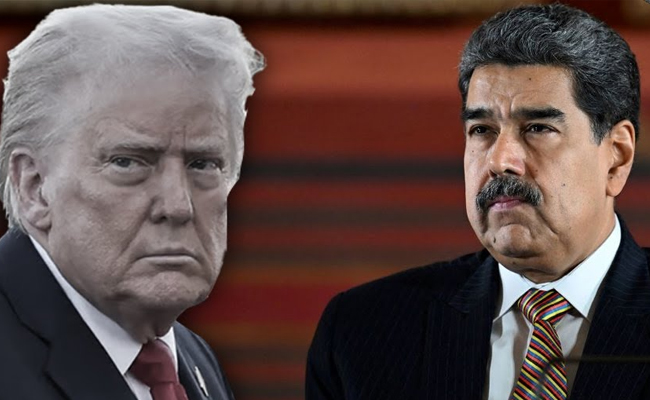
Though the headline may sound strange at first, this is being described as the reality. Early in the morning, the United States launched a sudden offensive against Venezuela. Bombs were reportedly dropped on the capital, Caracas. Simultaneously, a US Delta Force unit carried out an attack on the Venezuelan presidential palace. Within minutes, President Nicolás Maduro and his wife were detained and swiftly flown out of the country. This act can arguably be described as a kidnapping.
However, the real question is not that. What has triggered intense debate is whether the Venezuelan president, who was taken to the United States, is being kept alive or has been eliminated. Given the deep-rooted hostility between the two nations, such speculation has gained momentum.
For decades, relations between the United States and Venezuela have been hostile. Venezuela, which possesses vast oil reserves, has long been on America’s radar. During his first term itself, Donald Trump attempted to gain control over Venezuelan oil companies. However, Venezuela—having moved from communism toward socialism—had nationalized all its oil fields and companies decades ago.
As a result, Trump failed to establish dominance over Venezuela’s oil sector. After returning to power for a second term, he leveled fresh allegations against Venezuela, accusing it of flooding the United States with drugs. Trump claimed that President Maduro was hand-in-glove with drug cartels. Geographically, drug trafficking from Venezuela to the US is indeed feasible. Ships leaving Venezuela can reach places like Carolina, Georgia, New York, Washington, Boston, and Florida without passing through the closely monitored Gulf of Mexico. Even though the route passes near the notoriously dangerous Bermuda Triangle, Venezuelan vessels have so far not faced major obstacles.
In that sense, Trump’s claims may contain some truth. But attacking Venezuela and detaining its president on that basis alone appears to be an extreme step. In reality, drugs seem to be just a convenient excuse rather than the real reason.
The United States has long sought covert control over Venezuela, which has the world’s largest oil reserves. These efforts intensified after Trump came to power. However, this may not be as easy as Trump anticipates. In the 1950s, Venezuela and the US shared cordial relations, but over the past two decades, Venezuela has grown significantly closer to Russia and China.
As a result, Russia is expected to strongly oppose Trump’s actions. Russia has already responded by demanding an emergency meeting of the United Nations Security Council. Several countries, including Colombia, are reportedly supporting Russia’s stance.
Overall, it appears that US President Trump has ushered in a new global confrontation at the start of the new year. With the Israel–Hamas war ongoing on one front and the Ukraine–Russia conflict continuing on another, the world now faces the prospect of yet another major geopolitical crisis. The question remains: what turn will this dispute take in the days ahead?
Advertisment